
Federal Budget 2026-27: what it means for NDIS and aged care

The 2026-27 Federal Budget has now been released. If you or someone you care for needs NDIS supports or aged care services, you may be wondering what has changed and what happens next.
Some Budget measures are about funding. Others are linked to changes that will be introduced over time. Not everything will change at once, and some details still need to come through legislation, guidance and consultation.
This blog post highlights the key NDIS and aged care updates, so you can understand the main points and know where to look for more information.
What this means right now for NDIS & Aged care participants
Budget announcements can feel overwhelming, especially when they involve the NDIS, aged care and essential supports.
While these reforms are significant, not every change will happen straight away. Many updates are expected to be introduced over time, with more detail to come through legislation, consultation and official guidance.
For now, the most helpful step is to understand the main announcements, keep an eye on trusted sources, and ask questions if you are unsure how any changes may affect you or someone you care for.
Important NDIS updates from the Budget
The Federal Budget has now been released, giving more detail about the government's plans for the NDIS, aged care and disability support.
For NDIS participants and families, the Budget confirms that the government is continuing with major changes aimed at slowing scheme growth, improving provider oversight, strengthening fraud controls and making future access rules clearer.
These changes build on the NDIS announcements made in April 2026 and are expected to roll out over the next few years.
The Budget says the reforms are expected to save $37.8 billion over the next four years. It also says the NDIS will continue to grow each year and remain Australia's largest social program outside the Age Pension.
A new bill, the National Disability Insurance Scheme Amendment (Securing the NDIS for Future Generations) Bill, is expected after the release of the 2026-27 Budget.
At a glance - key NDIS measures
Quality services and supports - The Budget points to changes in plan management, support coordination, and home and living supports for some Supported Independent Living participants.
New eligibility rules - Future access is expected to focus more on how disability affects everyday life, using standardised assessments of functional capacity rather than diagnosis.
Slower cost growth - The government is planning tighter rules around plan reassessments, reasonable and necessary supports, some social and community participation budgets, and the move to new framework planning from April 2027.
Fraud and provider oversight - The Budget confirms stronger checks around providers and payments, along with stronger investigation and enforcement powers.
Inclusive Communities Fund - The Budget confirms a $200 million fund to help community organisations offer more genuine participation activities.
What this may mean for NDIS participants and families
These are significant reforms, and it is understandable if participants, families and carers have questions about what comes next.
The important thing to remember is that many changes are not expected to happen all at once. Several are planned to roll out over time, with more detail still to come through legislation, consultation and official NDIS guidance.
If you are unsure how any change may affect your own situation, speak with your support coordinator, plan manager, provider or the NDIS directly.
Key NDIS dates to keep in mind
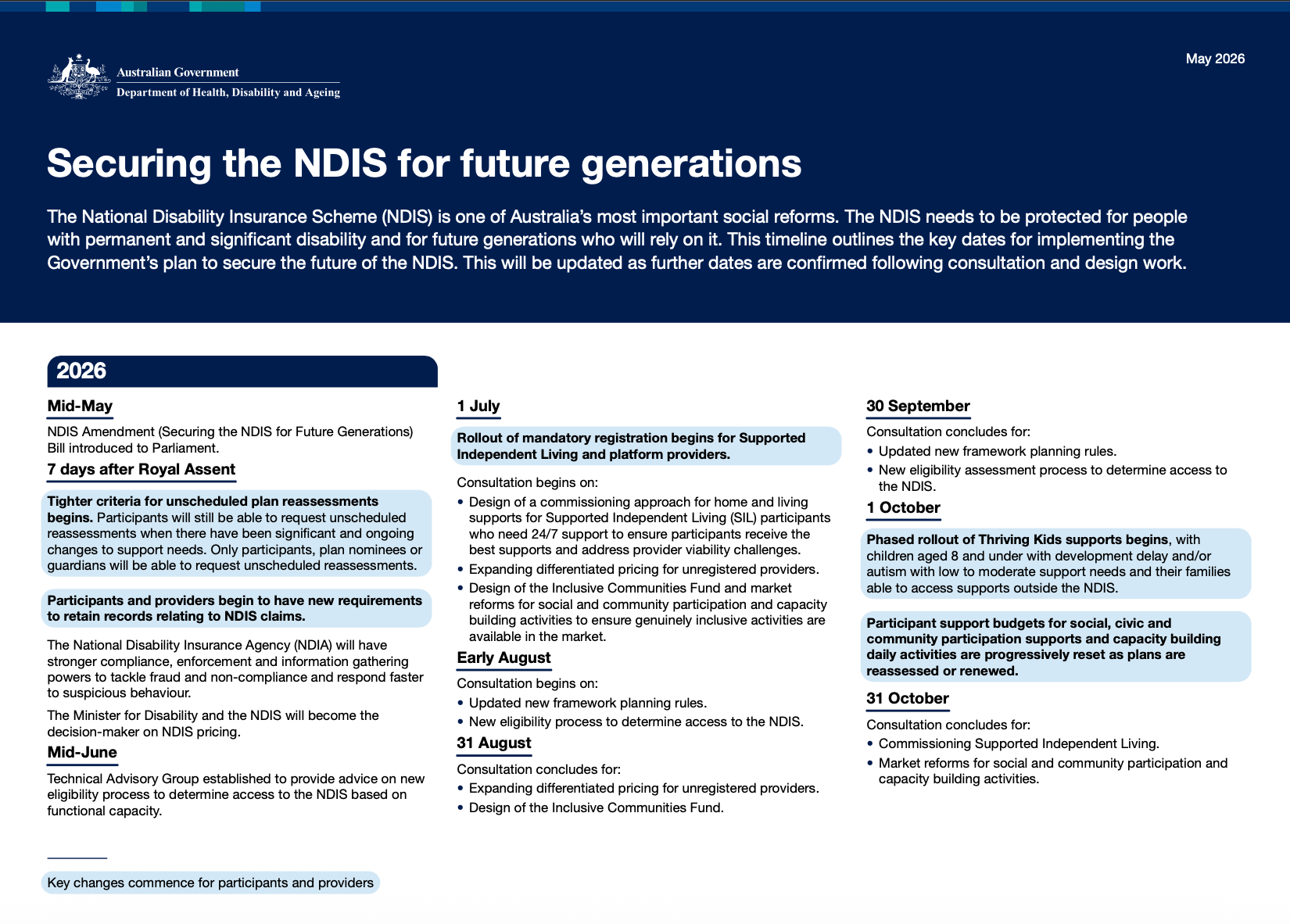
The NDIS has released an expected timeline for when changes may start. The full timeline can be found online at the health.gov.au website.
| Timing | What is changing | Why it matters for participants and families |
|---|---|---|
| Mid-May 2026 | NDIS Amendment Bill introduced to Parliament. | This starts the formal process for many of the planned NDIS changes. More detail may come as the Bill moves through Parliament. |
| 7 days after Royal Assent |
Tighter rules for unscheduled plan reassessments begin. Participants and providers begin to have new requirements to retain records relating to NDIS claims. |
Participants can still request an unscheduled reassessment when there have been significant and ongoing changes to support needs. Requests can only be made by participants, plan nominees or guardians. |
| Mid-June 2026 | Technical Advisory Group established for the new eligibility process. | This is an early step towards access decisions being based more clearly on functional capacity, or how disability affects day-to-day life. |
| 1 July 2026 |
Roll out of mandatory registration begins for Supported Independent Living and platform providers. Consultation begins on SIL home and living supports for participants who need 24/7 support. |
This is mainly relevant for participants in Supported Independent Living, or people who may need 24/7 home and living supports in future. |
| Early August 2026 | Consultation begins on new framework planning rules and the new eligibility process. | Participants and families may want to watch for updates about how future planning and access decisions will work. |
| 1 October 2026 | Thriving Kids supports begin rolling out for some children aged 8 and under. | Children aged 8 and under with developmental delay and/or autism with low to moderate support needs may be able to access supports outside the NDIS. |
| 1 October 2026 | Some social, civic and community participation budgets begin to be reset. | This happens progressively as plans are reassessed or renewed, so not every plan changes on the same day. |
| 1 February 2027 | Plan rollover changes begin for all participants. | When a plan reaches its scheduled reassessment date, a renewed plan will be created and unspent funds from the previous plan will not be carried over. |
| 1 February 2027 | Tighter assessment of reasonable and necessary supports begins for new entrants. | The NDIA will use new criteria when deciding what supports are funded. These changes will be applied progressively to current participants through usual reassessments. |
| 1 April 2027 | Participants start moving to new framework planning. | This is the start of the transition to new framework plans. Participants will move over time, not all at once. |
| 1 October 2027 | New panel of plan management providers begins, with a 6-month transition period. | This may matter for participants who use plan management. More detail will be needed on what the transition means for individual participants. |
| 1 January 2028 | Access changes begin for new applicants, with existing participants reassessed over 2 years. | Eligibility will be based on a new standardised, evidence-based assessment of functional capacity, with more consistent checks around permanence and other supports. |
| 1 January 2028 | Thriving Kids becomes fully operational nationally. | Children aged 8 and under with developmental delay and/or autism with low to moderate support needs will be supported by Thriving Kids instead of the NDIS. Children with permanent and significant disability or high support needs remain eligible, subject to usual arrangements. |
| 1 July 2028 | New support coordination and connection function begins. | This may affect how support coordination and connection services are organised in future. More detail will be needed before participants know what it means for their own arrangements. |
| 31 December 2030 | New framework planning transition period ends. | All participants are expected to have transitioned to new framework plans by this date. |
Dates and details may change as reforms progress. Participants and families should check official updates and seek advice about individual circumstances.
- *Source: Summarised from the NDIS reform timeline online version – please visit health.gov.au for the latest updates to timings https://www.health.gov.au/resources/publications/securing-the-ndis-for-future-generations-timeline-0?language=en
Aged care updates from the Budget
Aged care is also a major focus in the Budget.
The Budget says the government is investing $3.7 billion to deliver more beds, more packages and better care for older Australians.
At a glance - key aged care measures
Support at Home - The Budget provides $389.8 million to Support at Home packages, to make the programme fairer and more affordable.
Personal care under Support at Home - The Budget includes $1 billion to fully subsidise personal care services, such as showering, through Support at Home.
Dementia and hospital-to-aged-care support - The Budget includes funding for up to 20 extra Specialist Dementia Care units and an expansion of the Hospital to Aged Care Dementia Support Program from 11 to 20 locations nationally.
Quality, safety and viability - The Budget includes $565.1 million to support aged care sector quality, safety and viability.
Personal care under Support at Home
One Support at Home change is already clear, from 1 October 2026, the Australian Government will fully fund personal care for eligible Support at Home participants. This applies where personal care is approved in the person's support plan and they have available Support at Home funding.
Personal care includes support for showering, dressing and non-clinical continence management. Eligible participants will be able to receive approved personal care services with no out-of-pocket cost.
What this may mean for older Australians and families
For older Australians and families, the practical questions are likely to be about access, wait times, available services and costs.
The Budget points to fully funded personal care for eligible Support at Home participants, and more support for people with dementia and older people moving from hospital into aged care.
More detail may still be needed about how some measures will be delivered in practice, including timing, local availability and how people will access services.
What we do not know yet
The Budget confirms the broad direction and funding for several NDIS and aged care measures. It does not answer every practical question yet.
Some details may come through legislation, official guidance, consultation or programme updates over the months ahead.
For NDIS participants, this means watching for more information about timing, assessment processes, planning changes, budget settings and provider arrangements.
For older Australians, it means watching for more detail about Support at Home packages, personal care, dementia support and local service availability.
What happens next?
After the Budget, more detail is likely to be released through official government channels, including budget.gov.au, health.gov.au, ndis.gov.au and My Aged Care.
For now, participants, older Australians, families and carers can keep checking trusted sources and speak with their support coordinator, plan manager, provider, aged care contact, the NDIS or My Aged Care if they have questions about their own situation.
Need Help?
If you're looking for support with managing your NDIS plan or aged care, we're here to help. Feel free to reach out if you'd like to learn more. Call the BCD team on 1800 275 223, or contact us online through our contact form.
Information correct as at Tues May 5 2026. For the latest official information, visit budget.gov.au, health.gov.au and ndis.gov.au.
FAQs
What did the Budget say about the NDIS?
The Budget confirmed that NDIS reforms remain a major focus. Key areas include new eligibility rules, stronger provider and payment checks, tighter cost controls, more consistent planning, and measures to improve quality and support for participants.
Will NDIS changes happen straight away?
Not all changes will happen at once. Some changes are linked to legislation, consultation and staged rollout dates. Current and future participants should keep checking official NDIS and Health updates for confirmed timing.
What did the Budget say about aged care?
The Budget includes a $3.7 billion aged care package. This includes funding for Support at Home places, fully funded personal care for eligible participants, dementia care and hospital-to-aged-care support.
Will personal care under Support at Home be free?
From 1 October 2026, personal care under Support at Home is set to be fully government-funded for eligible participants, where personal care is approved in their support plan and they have available Support at Home funding.
Where can I find the latest official updates?
For the latest official information, check budget.gov.au, health.gov.au, ndis.gov.au and myagedcare.gov.au.
Information correct as at 12 May 2026. Please refer to the NDIS website or My Aged Care for the latest updates.
Sources:
NDIS reform timeline online version – please visit health.gov.au for the latest updates to timings https://www.health.gov.au/resources/publications/securing-the-ndis-for-future-generations-timeline-0?language=en
Health securing the NDIS page - NDIS rollout timing and next steps
NDIS announcement - NDIS reform announcement
My Aged Care personal care update - Support at Home personal care
Information correct as at 12 May 2026. Please refer to the NDIS website or My Aged Care for the latest updates.
The information provided in this blog post is for informational purposes only and should not be considered as legal, financial, or professional advice. While we strive to ensure the accuracy of the content, we encourage you to visit the relevant government websites for the most up-to-date and official information.