
What being a registered NDIS provider means (and why it matters)
At a glance
An NDIS provider is a person, business or organisation like BCD who delivers NDIS funded supports and services
There are registered and unregistered NDIS providers. Registered NDIS providers are regulated by the NDIS Quality and Safeguards Commission and must meet NDIS Practice Standards for quality and safety.
Registered NDIS providers can't charge more than the set NDIS Pricing Arrangements and NDIS Price Limits.
All NDIS providers must follow the NDIS Code of Conduct and have a complaints process in place.
In some cases, you must use registered providers, for example for NDIA-managed funding and certain supports.
Registration involves an audit against the NDIS Practice Standards, and the Commission also checks provider suitability.
IMPORTANT UPDATE: Looking for the latest NDIS changes?
For the latest announcements and what they may mean for participants, applicants and families, read our updated blog here or visit ndis.gov.au.

After 22 years supporting people and families in our local communities, at BCD, we've learned that what matters most is how safe, supported, and understood you feel day to day.
Choosing an NDIS provider is a very personal decision, and there are some really important things to consider when choosing who you want to work with. You'll be looking at whether they are the right fit for you, what their approach is and if they offer the supports needed for you to reach your goals.
You'll often hear people ask, "Are you registered?". Registration is one part of the picture.
It doesn't automatically tell you everything about the quality of a service, but it does explain the stringent standards, audits, and safeguards an NDIS provider must meet to be registered under the NDIS Quality and Safeguards Commission's regulatory framework.
Ultimately, the right provider is the one that best fits your needs, goals, and how your plan is managed.
First up, what is an NDIS provider?
The NDIS defines a provider as a person, business or organisation that delivers NDIS funded supports and services to participants.
There are registered and unregistered NDIS providers that offer services. If you're accessing the NDIS as a participant, you are responsible for choosing the providers you want to work with. You have choice and control in who you would like to have support you.
As you start comparing providers, you'll see that there are registered and unregistered NDIS providers. Here's what that means under the NDIS:
Registered vs Unregistered - what's the difference?
The NDIS describes two types of providers:
Registered providers are registered with and regulated by the NDIS Quality and Safeguards Commission and must meet strict NDIS Practice Standards for quality and safety.
Unregistered providers are not registered with the Commission.
| Feature | Registered NDIS Provider | Unregistered NDIS Provider |
|---|---|---|
| Pricing Limits | Must follow the NDIS Pricing Arrangements and Price Limits. | Can charge above or below NDIS price limits. |
| Quality & Safety Standards | Must meet strict quality and safety requirements set by the NDIS Commission. | Not required to go through formal audits, but still must provide safe and ethical supports and follow the NDIS Code of Conduct. |
| Audit & Regulation | Audited and regulated by the NDIS Quality and Safeguards Commission. | No formal registration or audit process required. |
| Code of Conduct | Must follow the NDIS Code of Conduct. | Must follow the NDIS Code of Conduct. |
| Participant Eligibility | Can be used by any participant. Required if funding is NDIA-managed. | Only available to participants who are self-managed or have a plan manager. |
| Supports Allowed | Can deliver all supports, including those that legally require registration (e.g. SDA,Specialist Behaviour Supports). | Cannot deliver certain supports that require registration (e.g. SDA,Specialist Behaviour Supports). |
Importantly, the NDIS also states that all providers must follow the NDIS Code of Conduct and have a complaints process. So both registered and unregistered NDIS providers must follow the code of conduct and have a process in place to address and respond to complaints..
Knowing the difference between registered and unregistered is helpful, but it's only one part of choosing a provider. Here's one thing we've learned that makes a real difference in day to day support.
A lesson we've learned over 22+ years: better outcomes come from working together.
Over time, as we've listened to our customers and their feedback, we've built a customer-led approach alongside our customers that keeps you at the centre, and brings the right team of people around you including carers and family with your consent and if you choose.
This is a core part of what has shaped our Senior Care Worker model and the 'village' of person-centred support we're known for. This customer-led approach doesn't just guide our growth, it shapes how we support people every day, focusing on meaningful connections and real outcomes.
Because choice and control sits at the heart of the NDIS, it also helps to know when you have flexibility to choose any provider, and when you're required to use a registered provider.
When do you have to use a registered NDIS provider?
The NDIS states you must use registered providers for:
Any parts of your funding that are NDIA/Agency-managed, and
Certain supports including plan management, behaviour support, supports likely to involve a regulated restricted practice, and Specialist Disability Accommodation (SDA).
For other supports, if your plan is self-managed or you use a registered plan manager, you can choose either registered or unregistered providers.
For many families, the next question is, what does 'registered' actually mean in practice? Here's what the registration process involves.
What does a provider have to do to become registered?
According to the NDIS Quality and Safeguards Commission a registered NDIS provider has:
Applied for registration with the Commission
Been audited against relevant NDIS Practice Standards and assessed as meeting them
Undergone a suitability assessment (of the provider and its key personnel) and been issued a certificate of registration.
The Commission also notes registered providers are generally registered for three years, and provider details are published on the NDIS Provider Register.
(Source: NDIS Commission 'About registration', pg. 1 )
The registration audit: a quality check against the NDIS Practice Standards
Becoming a registered provider is a comprehensive process where NDIS providers have to demonstrate they meet quality and safety requirements, including the relevant NDIS Practice Standards for the supports they deliver, through an audit.
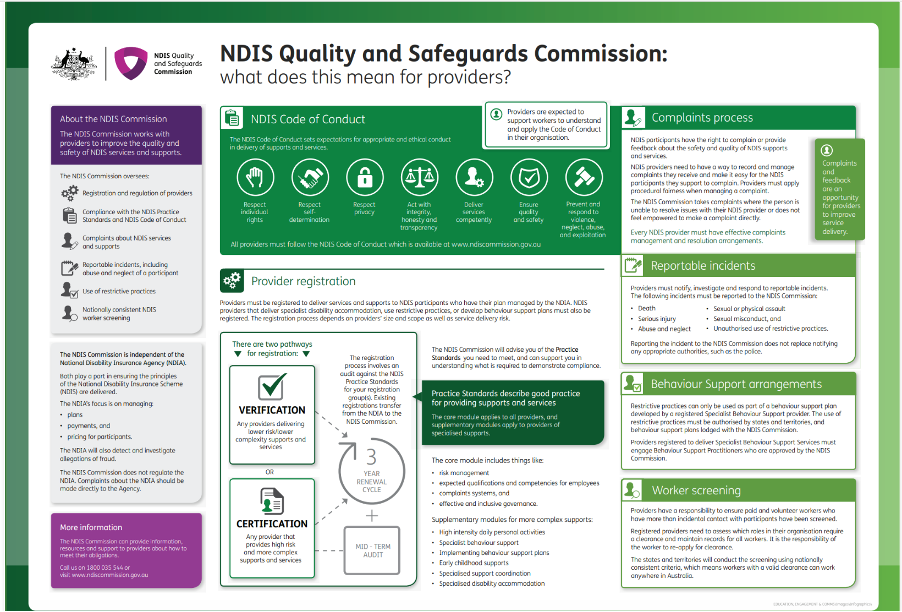
Source: NDIS Quality & Safeguards Commission Infographic PDF - https://www.ndiscommission.gov.au/sites/default/files/2022-07/ndis-commission-what-does-mean-providers-v3_0.pdf
What are the NDIS Practice Standards?
Think of the NDIS Practice Standards as the quality and safety benchmark providers are measured against. They're designed to show what safe, quality supports and services look like, and to help participants understand what quality service they should expect.
(Source: Practice Standards and Quality Indicators, p.4–5)
What does the audit look at?
The Commission explains the audit process is tied to the type of supports a provider delivers, and takes into account things like size, scope, and risk. During an audit, auditors assess providers against outcomes and quality indicators within the Standards, these indicators are used to check whether requirements are being met.
(Source: Practice Standards and Quality Indicators, p.4–5 and NDIS Commission infographic)
Suitability checks (including key staff)
As part of registration, providers must supply details of key personnel, and the Commission uses this to assess suitability, including whether there are past issues that may make someone unsuitable (for example convictions, enforcement actions or fraud).
(Source: NDIS Commission 'About registration', p.4–5)
Ongoing obligations - quality and safeguards
Registration also comes with ongoing conditions, including compliance with:
The applicable NDIS Practice Standards
The NDIS Code of Conduct
Relevant laws
Effective complaints and incident management systems
Worker screening clearances for certain roles (including key personnel)
Notification requirements and ongoing quality audit requirements
(Source: NDIS Commission 'About registration', pp.2–3)
What this means for you as a participant, family member or carer
For families, the takeaway is that registration involves independent checks and ongoing obligations designed to support safe and consistent services.
A registered provider should be able to clearly explain:
How they manage quality and safety day to day (not just on paper)
How you can give feedback or make a complaint
What happens if something goes wrong
How they support continuity when plans change or the unexpected happens
And if you're unhappy, you can change providers, and if you don't feel comfortable raising issues with the provider or you're unhappy with their response, you can contact the NDIS Quality and Safeguards Commission directly.
How we connect this to our approach
Registration explains the standards and safeguards registered NDIS providers must meet. For families and carers, the goal is simple, to feel confident support will be safe, reliable, and responsive when things change.
That's why our approach focuses on consistency, communication, and a team around you, shaped by what we've learned over time by listening to the people we support, and (with your consent) the carers and families who support them.
If you'd like to see what this looks like in practice, explore our Senior Care Worker model and the village of support behind each person's services.
If you're exploring your options or considering a change, we're here to answer questions and talk through what support could look like for you or a family member.
Need Help?
A BCD team member can walk you through what to do if you are thinking about changing your NDIS provider or want to learn more about the supports we provide. Call 1800 275 223 to speak to our BCD care team today or contact us online.
Sources
NDIS Commission Registered Providers Infographic https://www.ndiscommission.gov.au/sites/default/files/2022-07/ndis-commission-what-does-mean-providers-v3_0.pdf
NDIS Practice Standards - https://www.ndiscommission.gov.au/rules-and-standards/ndis-practice-standards
NDIS Practice Standards and Quality Indicators PDF
https://www.ndiscommission.gov.au/sites/default/files/2024-10/ndis-practice-standards-and-quality-indicators.pdf
NDIS Website: https://www.ndis.gov.au/
What Is A Provider: https://www.ndis.gov.au/participants/working-providers/what-provider
Disclaimer
The information provided in this blog post is for informational purposes only and should not be considered as legal, financial, or professional advice. While we strive to ensure the accuracy of the content, we encourage you to visit the relevant government websites for the most up-to-date and official information.